
Firearms retail is unlike almost any other consumer industry. Demand is rarely steady. Instead, it moves in sharp, often extreme cycles—driven less by traditional economic indicators and more by political ideology, proposed legislation, and perceived regulatory risk.
Retailers who fail to understand these cycles often experience the same painful pattern:
- Explosive sales followed by inventory shortages
- Over-ordering during panic periods
- Cash flow stress when demand collapses
- Excess inventory sitting stagnant during political “cool-downs”
Retailers who do understand these cycles, however, use them to stabilize revenue, protect margins, and position themselves ahead of competitors.
This article examines how political administrations and election cycles have historically driven firearms demand, what that has meant for retailers, distributors, and manufacturers—and how dealers today can apply those lessons to survive the next inevitable swing.
The Modern Political Demand Cycle Begins: 2008–2009
The contemporary firearms demand cycle can be clearly traced to the election of Barack Obama in 2008.
Pre-Election Panic Buying (2007–2008)
In the year leading up to the 2008 election, demand surged dramatically:
- Firearms inventories emptied rapidly
- Ammunition became scarce nationwide
- Prices rose sharply as supply chains tightened
- Backorders stacked at distributors and manufacturers
Retailers who had historically predictable ordering patterns suddenly found themselves unable to replenish stock at any meaningful pace.
This was not driven by crime trends or economic expansion—it was driven almost entirely by fear of regulation.
Post-Election Shockwaves (2009–2013)
Once in office, the administration’s rhetoric around gun control, combined with high-profile events and legislative pressure, sustained demand for years.
For retailers:
- Panic buying became normalized
- Customers bought ahead of perceived bans
- Ammo and magazines became speculative purchases
- Cash flow surged—but supply chains fractured
Manufacturers and distributors were forced to make difficult allocation decisions with limited production capacity.
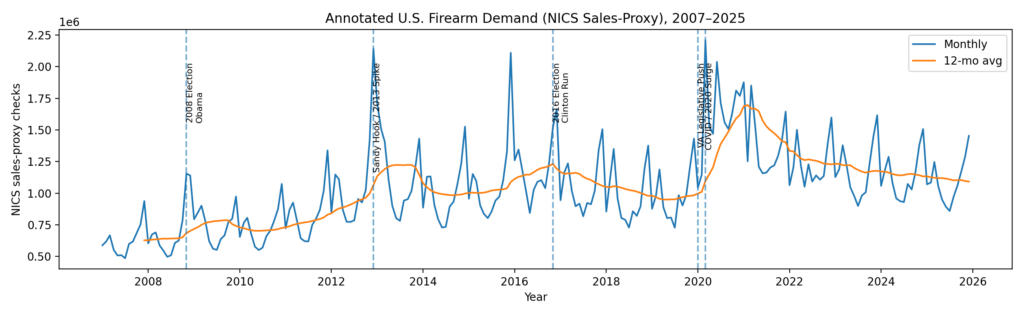
NICS checks are not a one-to-one measure of firearm sales. They are widely used within the firearms industry as a demand proxy and illustrate relative market trends rather than exact unit sales.
Allocation Reality: Who Actually Got Inventory?
During peak panic cycles, not all dealers were treated equally—a reality many retailers only understood after experiencing it firsthand.
Based on long-standing industry behavior, retailers most likely to receive inventory were those who:
- Maintained consistent historical ordering patterns
- Had no outstanding balances
- Could pay COD or early
- Did not overextend credit lines during surges
Retailers who attempted to place 10× normal ammunition orders, relied heavily on credit, or routinely paid at the end of extended terms often found themselves last in line—or skipped entirely.
This was not favoritism; it was risk management by distributors and manufacturers trying to survive unprecedented demand.
2016: The Second Major Ammunition Run
The next significant surge occurred during the 2016 election cycle when Hillary Clinton was the Democratic nominee.
Once again:
- Ammunition demand spiked dramatically
- AR-platform rifles surged
- Magazine sales exploded
- Customers bought years worth of ammo at once
Retailers who had learned from 2009–2013 navigated this period far better than those who assumed demand would remain permanent.
State-Level Cycles: The Virginia Example
While presidential elections create national demand waves, state-level administrations often generate even sharper local spikes.
In Virginia, the administration of Ralph Northam triggered precisely this effect.
Proposed state-level restrictions led to:
- Sudden local demand surges
- Concentrated buying in specific firearm categories
- Sharp increases in magazine and ammunition sales
- Followed by abrupt post-legislative slowdowns
For Virginia dealers, these cycles were compressed but intense, often leaving retailers with excess inventory once political pressure eased.
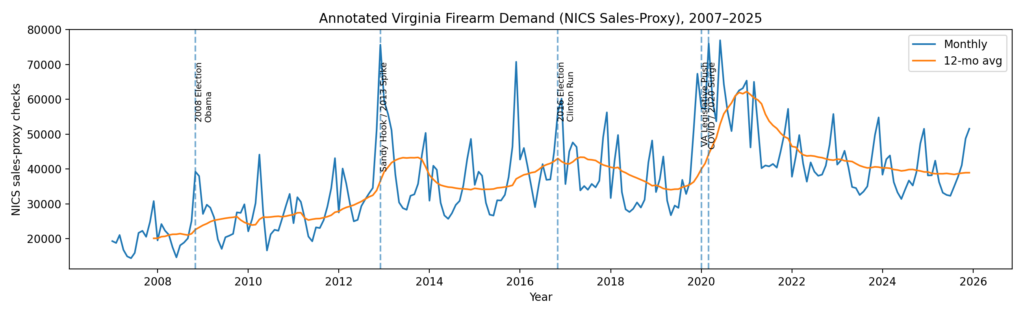
NICS checks are not a one-to-one measure of firearm sales. They are widely used within the firearms industry as a demand proxy and illustrate relative market trends rather than exact unit sales.
The Core Problem: Confusing Demand With Sustainability
The single most dangerous mistake firearms retailers make during politically driven booms is assuming:
“This is the new normal.”
It rarely is.
Political demand is:
- Reactive
- Short-term
- Emotionally driven
- Highly concentrated
Once legislation passes—or fails—sales often fall off dramatically, sometimes overnight.
Retailers left holding excessive inventory face:
- Cash flow constraints
- Depressed margins
- Forced discounting
- Strained distributor relationships
The Balancing Act: Cash Flow vs. Inventory Risk
Successful retailers treat panic demand as a revenue opportunity, not a business model.
Key principles include:
1. Cash Flow First
During surges, liquidity matters more than volume.
- Avoid tying up capital in speculative inventory
- Maintain the ability to pivot quickly
2. Controlled Inventory Expansion
Increase inventory strategically, not emotionally.
- Prioritize fast-turn categories
- Avoid deep speculation on politically sensitive SKUs
3. Distributor Relationship Management
Your payment history matters.
- Consistent ordering beats sporadic surges
- Strong credit discipline increases allocation likelihood
The Value of Historical Data (Your Most Overlooked Asset)
Retailers who survived multiple cycles have something invaluable: their own data.
Reviewing:
- Sales volume by category
- Inventory turn rates
- Order fulfillment timelines
- Payment terms vs. allocation success
…allows dealers to forecast future cycles with far greater accuracy than industry headlines ever will.
Political swings are not random—they are patterned.
Today’s Reality: Ideology Drives Demand More Than Ever
Today, political ideology—not just legislation—is driving firearms purchasing behavior.
In Virginia, current proposed legislation aimed at outlawing specific firearms and magazines has once again triggered:
- Accelerated buying ahead of enactment
- Significant short-term revenue growth
- Looming post-July 1 demand contraction
Retailers must plan now for what comes after the surge—not during it.
Planning for the Inevitable Slowdown
Every surge ends.
Retailers should already be asking:
- What inventory will remain once demand cools?
- How quickly can we liquidate excess stock?
- What fixed costs must be covered during slow periods?
- How do we stabilize revenue without panic sales?
Those who plan early survive comfortably.
Those who don’t are forced into reactive decisions.
Final Thoughts: Political Cycles Are a Constant—Preparation Is the Variable
Firearms retailers cannot control political administrations, elections, or ideology.
They can control:
- Inventory discipline
- Cash flow management
- Data-driven forecasting
- Distributor relationships
Retailers who treat political demand cycles as predictable events—not surprises—position themselves to profit during surges and remain solvent when they end.
The difference between survival and failure is rarely sales volume.
It’s planning.