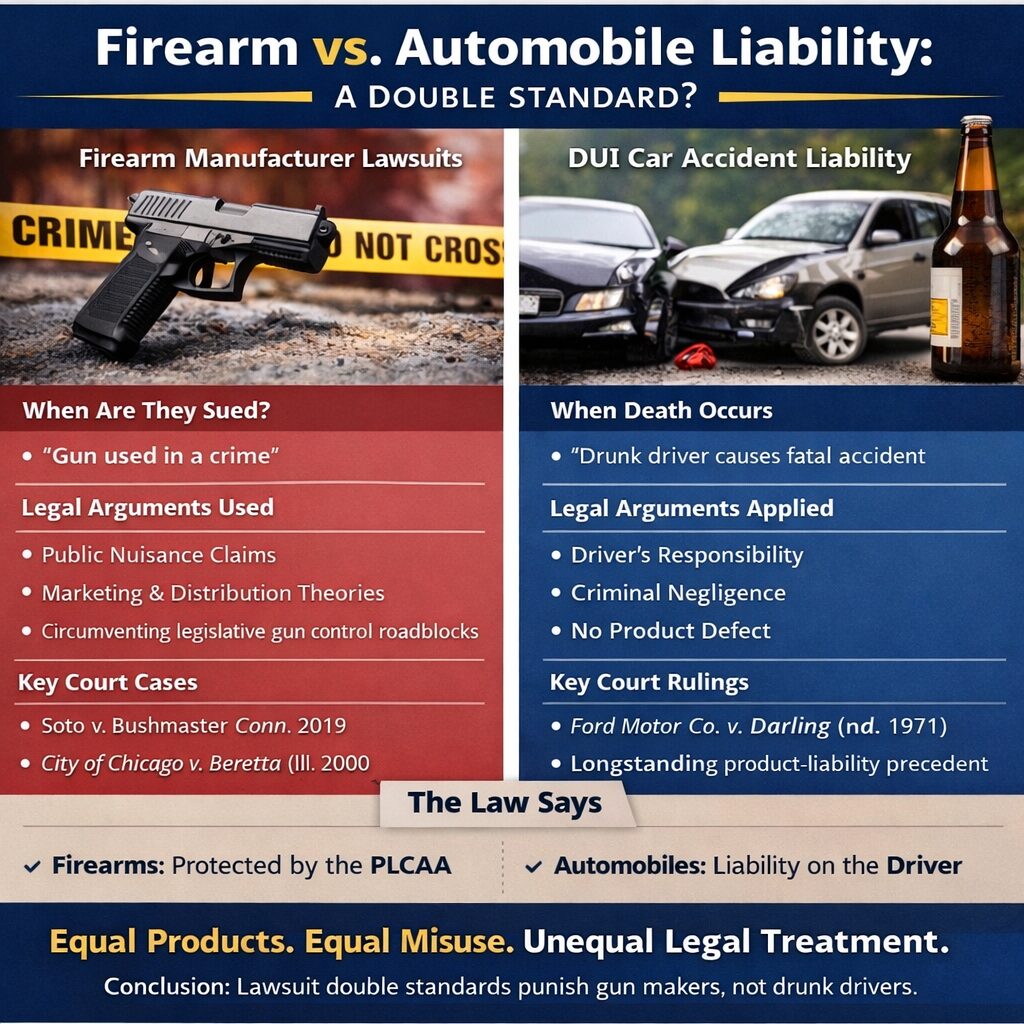
When a drunk driver kills someone, we do not sue Ford, Chevrolet, or Toyota.
But when a criminal uses a firearm to commit murder, many politicians believe it is appropriate to sue the firearm manufacturer.
To many Americans, this raises a fundamental question of fairness, logic, and responsibility:
Why is a lawful manufacturer blamed for the criminal misuse of its product — when no other industry is treated the same way?
Understanding the answer requires examining the political motivations, legal frameworks, and public narratives that surround firearms in America.
The Core Legal Principle: Responsibility Follows the Criminal Actor
In nearly every other industry, the legal system follows a simple principle:
Manufacturers are responsible for defective products — not criminal misuse.
If a car’s brakes fail due to a defect, the automaker can be sued.
If a gun explodes due to faulty metallurgy, the firearm company can be sued.
If a ladder collapses due to bad design, the manufacturer can be sued.
But if a product works exactly as designed and is misused by a criminal, liability rests with the criminal — not the manufacturer.
That is why:
- Ford is not sued when a drunk driver kills a family.
- Budweiser is not sued when an intoxicated patron causes a fatal crash.
- Kitchen knife companies are not sued when a criminal commits a stabbing.
The crime is the fault of the criminal.
Why Firearms Are Treated Differently
Firearms occupy a unique place in American politics. Unlike cars, alcohol, or knives, guns are directly tied to constitutional rights, culture, and political identity.
For many progressive and gun-control-focused politicians, firearms are not viewed as neutral consumer tools. They are viewed as a social problem that must be reduced, restricted, or eliminated.
Since outright bans face constitutional barriers, litigation becomes an alternative strategy.
Lawsuits as a Political Tool
When politicians support lawsuits against firearms manufacturers, the goal is often not justice — it is pressure.
These lawsuits are designed to:
- Increase operating costs for manufacturers
- Discourage banks and insurers from working with the industry
- Bankrupt smaller companies
- Create regulatory effects that Congress cannot pass
In short, the courtroom becomes a weapon to achieve political outcomes.
The Protection of Lawful Commerce in Arms Act (PLCAA)
Recognizing this tactic, Congress passed the Protection of Lawful Commerce in Arms Act (PLCAA) in 2005.
PLCAA does one simple thing:
It prevents gun manufacturers and dealers from being held liable when their products are used in crimes — as long as they followed the law and sold a non-defective product.
This law exists because before PLCAA, cities and states openly admitted they were using lawsuits to try to destroy the firearms industry through legal expenses alone.
Even today, some states attempt to bypass PLCAA by inventing new liability theories that no other industry faces.
The Automobile Comparison
The automobile analogy is especially revealing.
Cars kill more Americans each year than firearms.
Drunk driving kills over 13,000 people annually.
Yet no one argues that automakers should be sued for selling fast cars, powerful engines, or large trucks.
Why?
Because society understands that:
- A car is a lawful tool
- The driver controls the car
- The crime is the driver’s responsibility
The same logic applies to firearms.
A firearm is a lawful tool.
The user controls the firearm.
The crime is the criminal’s responsibility.
The tool did not commit the crime.
Why the Double Standard Exists
The difference is not legal — it is ideological.
Firearms represent:
- The Second Amendment
- Individual self-defense
- Decentralized power
- Personal responsibility
For politicians who oppose civilian gun ownership, attacking manufacturers is a way to attack gun ownership itself.
If the industry disappears, access disappears.
Litigation becomes prohibition by another name.
The Real Consequences
When firearm manufacturers are sued for criminal acts they did not commit:
- Law-abiding gun owners pay higher prices
- Small family-owned manufacturers go out of business
- Innovation slows
- Law enforcement supply chains are disrupted
- Rural economies suffer
Meanwhile, criminals remain unaffected.
The lawsuits do not stop crime.
They simply punish lawful commerce.
Conclusion: Equal Justice Requires Equal Standards
If we do not sue automakers for drunk drivers…
If we do not sue alcohol companies for intoxicated violence…
If we do not sue knife makers for stabbings…
Then we should not sue firearm manufacturers for crimes they did not commit.
Justice requires consistency.
Responsibility requires accountability.
And the blame for violent crime belongs where it always has — on the criminal.
Not the tool.