Creative Capital Strategies for Emerging Firearms Manufacturers

Growing Without Giving Up Control

Launching a firearms manufacturing company is capital-intensive by nature. Tooling, materials, subcontracted components, compliance, testing, inventory, and marketing all require cash—often long before consistent revenue begins to flow.

For many emerging manufacturers, traditional options such as venture capital, majority investors, or long-term loans are either undesirable or impractical. Giving up control too early, taking on excessive debt, or committing to repayment schedules that don’t match production cycles can put a promising product at risk.

Fortunately, there are creative, incremental capital strategies that allow firearms manufacturers to grow, validate demand, and improve cash flow—without surrendering ownership or autonomy. These strategies are especially effective for companies that subcontract component manufacturing and perform final assembly or finishing in-house.


The Capital Reality of Modern Firearms Manufacturing

Most new firearms manufacturers today operate in a hybrid production environment:

  • Barrels, receivers, or components produced by subcontractors
  • Final assembly, fitting, finishing, and QC performed in-house
  • Small production runs to control risk and validate demand
  • Limited working capital tied up in parts and inventory

This model reduces upfront capital investment in machinery but increases dependence on cash flow timing. Capital is often needed in short bursts—materials, production runs, marketing pushes—rather than one large infusion.

That reality creates an opportunity for alternative funding structures.


Inventory-Based Investing: Funding Production, Not the Company

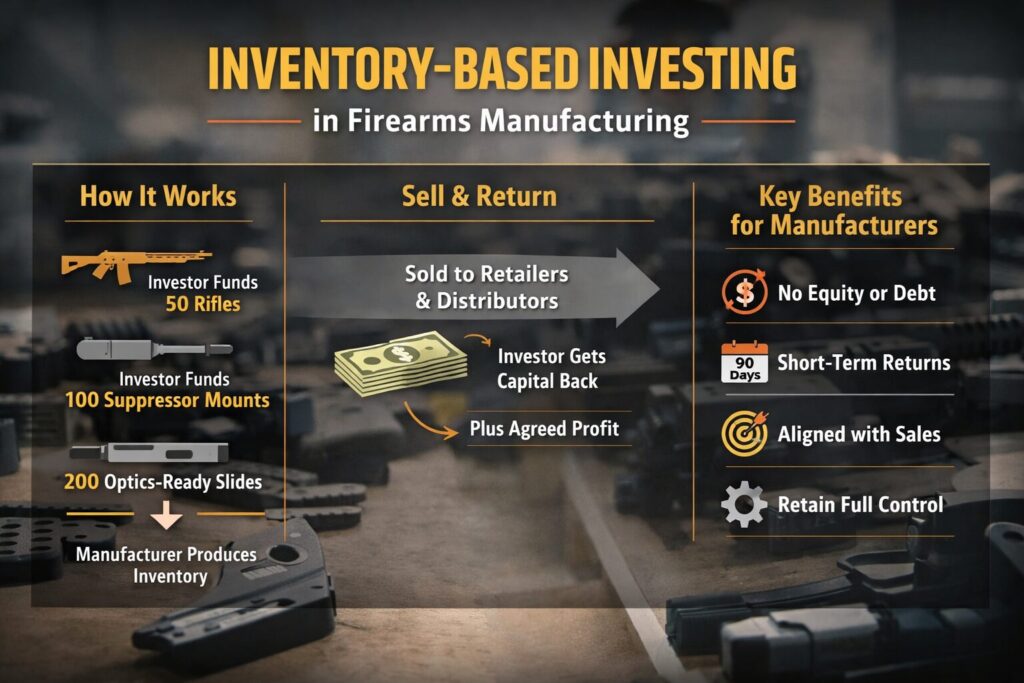
Creative capital model showing inventory-based investing for firearms manufacturers
Inventory-based investing allows manufacturers to fund production runs while retaining ownership and control.

One of the most effective short-term capital strategies is inventory-based investing.

How It Works

Instead of investing in the company itself, an investor funds the production of a specific quantity of product—for example:

  • 50 rifles
  • 100 suppressor mounts
  • 200 optics-ready slides

The manufacturer produces and sells that inventory through existing retail or distributor channels. Once the inventory sells, the investor receives:

  • Their original capital
  • A pre-agreed fixed return (not equity, not revenue share)

Why This Works for Firearms Manufacturers

  • Investors understand exactly what they are funding
  • Risk is tied to sell-through, not company ownership
  • Manufacturers retain full control
  • Short investment horizon (often 60–120 days)
  • Easy to scale as demand increases

This model is particularly attractive to:

  • Industry insiders
  • Retailers
  • Enthusiasts who believe in the product

Key advantage: Capital is directly aligned with production and sales, not long-term valuation speculation.


Retailer Partnerships as Capital and Marketing Engines

Retailer partnership model connecting firearms manufacturers with potential investors through VIP events and product demos
Retailer VIP events and demonstrations can create natural introductions between manufacturers and prospective investors.

Retailers are often overlooked as a capital resource—but they shouldn’t be.

Many firearms retailers already operate VIP programs, private events, range memberships, or invitation-only customer groups. These environments are ideal for introducing new manufacturers and products.

Strategic Retailer Collaborations

Rather than approaching retailers strictly as buyers, manufacturers can create collaborative partnerships, such as:

  • Exclusive early-release products
  • Retailer-hosted demo days
  • Meet-and-greet events with the manufacturer
  • Limited-run models branded for the retailer

When retailers are genuinely excited about a product, they often become advocates—not just sellers.


VIP Events and Demo Days as Investor Discovery Tools

High-end retailers with VIP clientele offer a unique opportunity: capital exposure without a pitch deck.

How This Strategy Works

  • Manufacturer partners with a retailer for a private demo or event
  • VIP customers experience the product firsthand
  • Manufacturer shares the product story, development process, and growth vision
  • Interested attendees are introduced to small, structured investment opportunities, such as inventory-based investing

This approach works because:

  • Attendees already trust the retailer
  • They value exclusivity and access
  • They often have disposable capital
  • They are emotionally connected to the product

These events blur the line—in a good way—between customer, advocate, and investor.


Multiple Small Investors Instead of One Controlling Partner

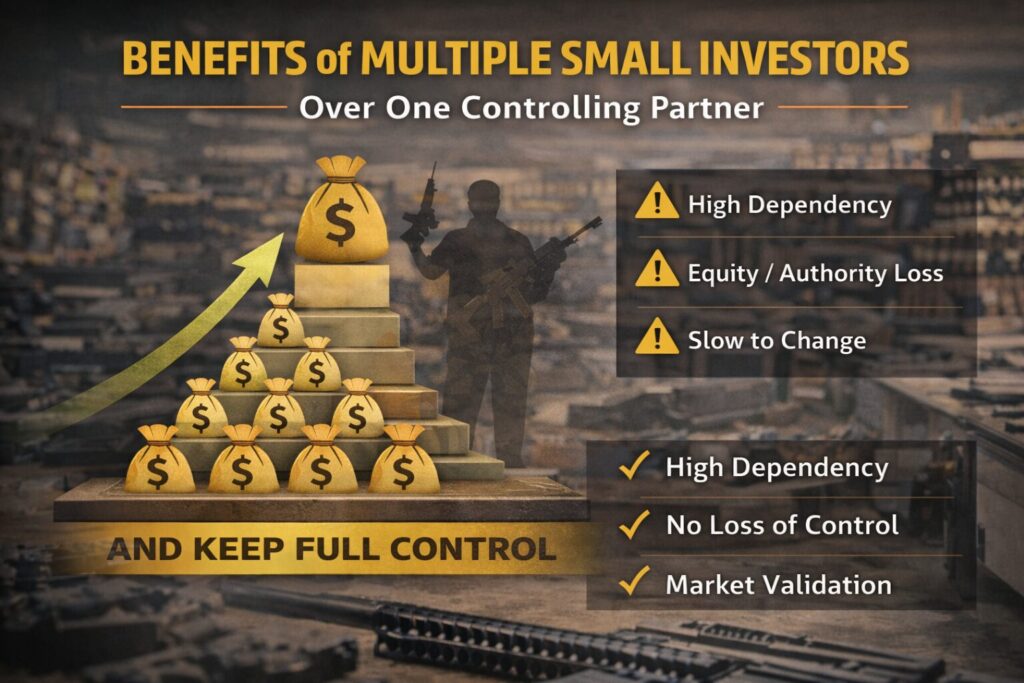
Benefits of using multiple small investors instead of one controlling partner in firearms manufacturing
Working with multiple smaller investors can reduce dependency, improve flexibility, and help manufacturers maintain control.

One of the biggest mistakes new manufacturers make is believing they need one large investor to succeed.

In reality, many companies grow faster and safer by securing:

  • Multiple small capital contributors
  • Short-term, purpose-driven investments
  • Repeat investors as confidence builds

Benefits include:

  • Reduced dependency on a single individual
  • No loss of strategic control
  • Organic validation of product demand
  • Stronger industry relationships

As excitement grows and sales data accumulates, cash flow improves—and future capital becomes easier and less expensive to secure.


Why This Matters in a Subcontracted Manufacturing Model

When parts are outsourced and final assembly happens in-house, capital is often locked in:

  • Deposits to subcontractors
  • Work-in-progress inventory
  • Finished goods awaiting sell-through

Creative capital strategies allow manufacturers to:

  • Fund production runs efficiently
  • Avoid overproduction
  • Match capital deployment to actual demand
  • Scale responsibly without overextending

This is especially critical in the firearms industry, where market shifts, regulatory pressure, and consumer trends can change quickly.


Final Thoughts: Capital Should Support Growth, Not Control It

Emerging firearms manufacturers don’t need to give away the company to grow. By thinking creatively—leveraging inventory-based investing, retailer partnerships, VIP experiences, and multiple small investors—manufacturers can:

  • Maintain ownership and vision
  • Improve cash flow
  • Validate market demand
  • Build long-term industry relationships

The key is aligning capital with production, sales, and excitement, rather than chasing traditional funding models that don’t fit the realities of firearms manufacturing.


Consulting Insight

At Virginia Innovations, Inc., we help firearms manufacturers structure realistic growth strategies, analyze production economics, and develop retailer and investor-friendly programs that align with real-world industry dynamics.

If you found this discussion helpful, you can explore more firearms industry insights on our blog, where we cover manufacturing strategy, valuations, market trends, and growth planning for companies across the industry.

Explore more firearms industry insights on our blog

Why Are Firearms Manufacturers Sued for Criminal Misuse — But Automakers Are Not?

When a drunk driver kills someone, we do not sue Ford, Chevrolet, or Toyota.

But when a criminal uses a firearm to commit murder, many politicians believe it is appropriate to sue the firearm manufacturer.

To many Americans, this raises a fundamental question of fairness, logic, and responsibility:

Why is a lawful manufacturer blamed for the criminal misuse of its product — when no other industry is treated the same way?

Understanding the answer requires examining the political motivations, legal frameworks, and public narratives that surround firearms in America.


The Core Legal Principle: Responsibility Follows the Criminal Actor

Side-by-side infographic comparing firearm manufacturer lawsuits with automobile manufacturer liability in DUI deaths, highlighting legal standards, court cases, and PLCAA protections
A comparison of how firearm manufacturers and automobile manufacturers are treated under U.S. law when their products are criminally misused.

In nearly every other industry, the legal system follows a simple principle:

Manufacturers are responsible for defective products — not criminal misuse.

If a car’s brakes fail due to a defect, the automaker can be sued.
If a gun explodes due to faulty metallurgy, the firearm company can be sued.
If a ladder collapses due to bad design, the manufacturer can be sued.

But if a product works exactly as designed and is misused by a criminal, liability rests with the criminal — not the manufacturer.

That is why:

  • Ford is not sued when a drunk driver kills a family.
  • Budweiser is not sued when an intoxicated patron causes a fatal crash.
  • Kitchen knife companies are not sued when a criminal commits a stabbing.

The crime is the fault of the criminal.


Why Firearms Are Treated Differently

Firearms occupy a unique place in American politics. Unlike cars, alcohol, or knives, guns are directly tied to constitutional rights, culture, and political identity.

For many progressive and gun-control-focused politicians, firearms are not viewed as neutral consumer tools. They are viewed as a social problem that must be reduced, restricted, or eliminated.

Since outright bans face constitutional barriers, litigation becomes an alternative strategy.

Lawsuits as a Political Tool

When politicians support lawsuits against firearms manufacturers, the goal is often not justice — it is pressure.

These lawsuits are designed to:

  • Increase operating costs for manufacturers
  • Discourage banks and insurers from working with the industry
  • Bankrupt smaller companies
  • Create regulatory effects that Congress cannot pass

In short, the courtroom becomes a weapon to achieve political outcomes.


The Protection of Lawful Commerce in Arms Act (PLCAA)

Recognizing this tactic, Congress passed the Protection of Lawful Commerce in Arms Act (PLCAA) in 2005.

PLCAA does one simple thing:

It prevents gun manufacturers and dealers from being held liable when their products are used in crimes — as long as they followed the law and sold a non-defective product.

This law exists because before PLCAA, cities and states openly admitted they were using lawsuits to try to destroy the firearms industry through legal expenses alone.

Even today, some states attempt to bypass PLCAA by inventing new liability theories that no other industry faces.


The Automobile Comparison

The automobile analogy is especially revealing.

Cars kill more Americans each year than firearms.
Drunk driving kills over 13,000 people annually.
Yet no one argues that automakers should be sued for selling fast cars, powerful engines, or large trucks.

Why?

Because society understands that:

  • A car is a lawful tool
  • The driver controls the car
  • The crime is the driver’s responsibility

The same logic applies to firearms.

A firearm is a lawful tool.
The user controls the firearm.
The crime is the criminal’s responsibility.

The tool did not commit the crime.


Why the Double Standard Exists

The difference is not legal — it is ideological.

Firearms represent:

  • The Second Amendment
  • Individual self-defense
  • Decentralized power
  • Personal responsibility

For politicians who oppose civilian gun ownership, attacking manufacturers is a way to attack gun ownership itself.

If the industry disappears, access disappears.

Litigation becomes prohibition by another name.


The Real Consequences

When firearm manufacturers are sued for criminal acts they did not commit:

  • Law-abiding gun owners pay higher prices
  • Small family-owned manufacturers go out of business
  • Innovation slows
  • Law enforcement supply chains are disrupted
  • Rural economies suffer

Meanwhile, criminals remain unaffected.

The lawsuits do not stop crime.
They simply punish lawful commerce.


Conclusion: Equal Justice Requires Equal Standards

If we do not sue automakers for drunk drivers…
If we do not sue alcohol companies for intoxicated violence…
If we do not sue knife makers for stabbings…

Then we should not sue firearm manufacturers for crimes they did not commit.

Justice requires consistency.
Responsibility requires accountability.
And the blame for violent crime belongs where it always has — on the criminal.

Not the tool.

How Firearms Retailers Can Survive (and Thrive) Through Politically Driven Demand Cycles

Firearms retail is unlike almost any other consumer industry. Demand is rarely steady. Instead, it moves in sharp, often extreme cycles—driven less by traditional economic indicators and more by political ideology, proposed legislation, and perceived regulatory risk.

Firearms and ammunition displayed with U.S. Capitol imagery representing politically driven demand cycles affecting firearms retailers and inventory planning.
Firearms retail demand has historically surged and declined in response to political administrations, elections, and proposed legislation.

Retailers who fail to understand these cycles often experience the same painful pattern:

  • Explosive sales followed by inventory shortages
  • Over-ordering during panic periods
  • Cash flow stress when demand collapses
  • Excess inventory sitting stagnant during political “cool-downs”

Retailers who do understand these cycles, however, use them to stabilize revenue, protect margins, and position themselves ahead of competitors.

This article examines how political administrations and election cycles have historically driven firearms demand, what that has meant for retailers, distributors, and manufacturers—and how dealers today can apply those lessons to survive the next inevitable swing.


The Modern Political Demand Cycle Begins: 2008–2009

The contemporary firearms demand cycle can be clearly traced to the election of Barack Obama in 2008.

Pre-Election Panic Buying (2007–2008)

In the year leading up to the 2008 election, demand surged dramatically:

  • Firearms inventories emptied rapidly
  • Ammunition became scarce nationwide
  • Prices rose sharply as supply chains tightened
  • Backorders stacked at distributors and manufacturers

Retailers who had historically predictable ordering patterns suddenly found themselves unable to replenish stock at any meaningful pace.

This was not driven by crime trends or economic expansion—it was driven almost entirely by fear of regulation.

Post-Election Shockwaves (2009–2013)

Once in office, the administration’s rhetoric around gun control, combined with high-profile events and legislative pressure, sustained demand for years.

For retailers:

  • Panic buying became normalized
  • Customers bought ahead of perceived bans
  • Ammo and magazines became speculative purchases
  • Cash flow surged—but supply chains fractured

Manufacturers and distributors were forced to make difficult allocation decisions with limited production capacity.

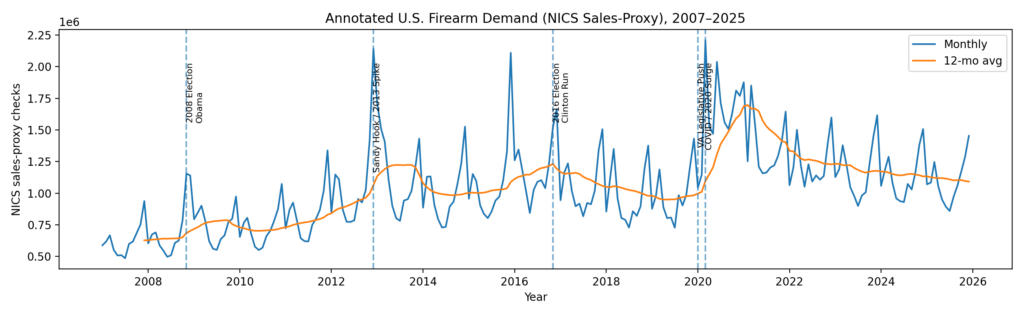
Annotated U.S. firearm demand chart using FBI NICS background check data from 2007 to 2025, showing politically driven sales spikes during elections, legislation, and major events.
Annotated FBI NICS background check data illustrating recurring U.S. firearms demand spikes tied to elections, legislation, and political uncertainty from 2007–2025.

NICS checks are not a one-to-one measure of firearm sales. They are widely used within the firearms industry as a demand proxy and illustrate relative market trends rather than exact unit sales.


Allocation Reality: Who Actually Got Inventory?

During peak panic cycles, not all dealers were treated equally—a reality many retailers only understood after experiencing it firsthand.

Based on long-standing industry behavior, retailers most likely to receive inventory were those who:

  • Maintained consistent historical ordering patterns
  • Had no outstanding balances
  • Could pay COD or early
  • Did not overextend credit lines during surges

Retailers who attempted to place 10× normal ammunition orders, relied heavily on credit, or routinely paid at the end of extended terms often found themselves last in line—or skipped entirely.

This was not favoritism; it was risk management by distributors and manufacturers trying to survive unprecedented demand.


2016: The Second Major Ammunition Run

The next significant surge occurred during the 2016 election cycle when Hillary Clinton was the Democratic nominee.

Once again:

  • Ammunition demand spiked dramatically
  • AR-platform rifles surged
  • Magazine sales exploded
  • Customers bought years worth of ammo at once

Retailers who had learned from 2009–2013 navigated this period far better than those who assumed demand would remain permanent.


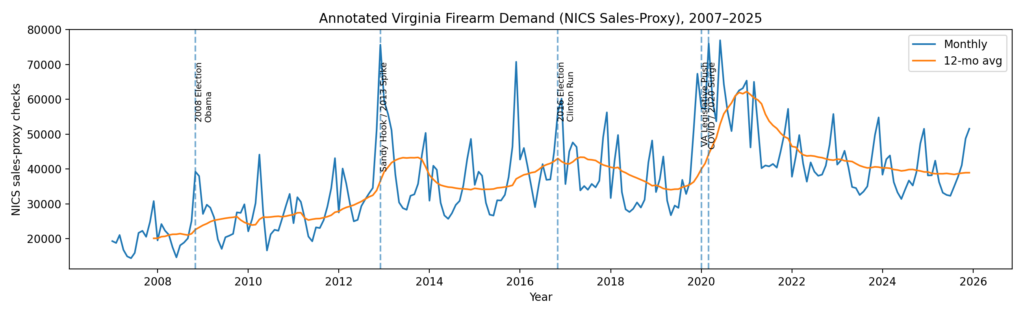
State-Level Cycles: The Virginia Example

While presidential elections create national demand waves, state-level administrations often generate even sharper local spikes.

In Virginia, the administration of Ralph Northam triggered precisely this effect.

Proposed state-level restrictions led to:

  • Sudden local demand surges
  • Concentrated buying in specific firearm categories
  • Sharp increases in magazine and ammunition sales
  • Followed by abrupt post-legislative slowdowns

For Virginia dealers, these cycles were compressed but intense, often leaving retailers with excess inventory once political pressure eased.

Annotated Virginia firearm demand chart using FBI NICS background check data from 2007 to 2025, showing state-level sales spikes driven by elections, legislation, and political pressure.
Annotated FBI NICS background check data illustrating Virginia-specific firearms demand spikes tied to elections, legislation, and state political uncertainty from 2007–2025.

NICS checks are not a one-to-one measure of firearm sales. They are widely used within the firearms industry as a demand proxy and illustrate relative market trends rather than exact unit sales.


The Core Problem: Confusing Demand With Sustainability

The single most dangerous mistake firearms retailers make during politically driven booms is assuming:

“This is the new normal.”

It rarely is.

Political demand is:

  • Reactive
  • Short-term
  • Emotionally driven
  • Highly concentrated

Once legislation passes—or fails—sales often fall off dramatically, sometimes overnight.

Retailers left holding excessive inventory face:

  • Cash flow constraints
  • Depressed margins
  • Forced discounting
  • Strained distributor relationships

The Balancing Act: Cash Flow vs. Inventory Risk

Successful retailers treat panic demand as a revenue opportunity, not a business model.

Key principles include:

1. Cash Flow First

During surges, liquidity matters more than volume.

  • Avoid tying up capital in speculative inventory
  • Maintain the ability to pivot quickly

2. Controlled Inventory Expansion

Increase inventory strategically, not emotionally.

  • Prioritize fast-turn categories
  • Avoid deep speculation on politically sensitive SKUs

3. Distributor Relationship Management

Your payment history matters.

  • Consistent ordering beats sporadic surges
  • Strong credit discipline increases allocation likelihood

The Value of Historical Data (Your Most Overlooked Asset)

Retailers who survived multiple cycles have something invaluable: their own data.

Reviewing:

  • Sales volume by category
  • Inventory turn rates
  • Order fulfillment timelines
  • Payment terms vs. allocation success

…allows dealers to forecast future cycles with far greater accuracy than industry headlines ever will.

Political swings are not random—they are patterned.


Today’s Reality: Ideology Drives Demand More Than Ever

Today, political ideology—not just legislation—is driving firearms purchasing behavior.

In Virginia, current proposed legislation aimed at outlawing specific firearms and magazines has once again triggered:

  • Accelerated buying ahead of enactment
  • Significant short-term revenue growth
  • Looming post-July 1 demand contraction

Retailers must plan now for what comes after the surge—not during it.


Planning for the Inevitable Slowdown

Every surge ends.

Retailers should already be asking:

  • What inventory will remain once demand cools?
  • How quickly can we liquidate excess stock?
  • What fixed costs must be covered during slow periods?
  • How do we stabilize revenue without panic sales?

Those who plan early survive comfortably.
Those who don’t are forced into reactive decisions.


Final Thoughts: Political Cycles Are a Constant—Preparation Is the Variable

Firearms retailers cannot control political administrations, elections, or ideology.

They can control:

  • Inventory discipline
  • Cash flow management
  • Data-driven forecasting
  • Distributor relationships

Retailers who treat political demand cycles as predictable events—not surprises—position themselves to profit during surges and remain solvent when they end.

The difference between survival and failure is rarely sales volume.

It’s planning.


What Makes a Firearms Appraisal Legally Defensible

Firearms appraisals are used for far more than buying and selling decisions. They are relied upon in estate settlements, probate, divorce proceedings, insurance claims, charitable donations, litigation, and tax matters. In these contexts, an appraisal is not merely an opinion—it is often scrutinized as evidence.

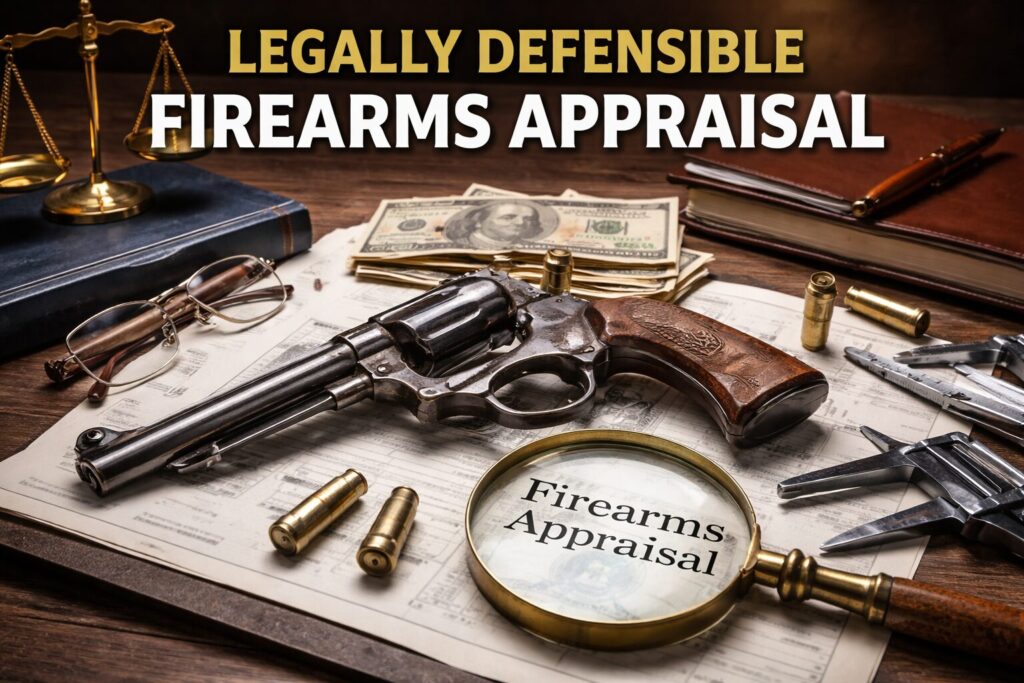
Legally defensible firearms appraisal showing documented valuation, condition analysis, and market evidence
Professional firearms appraisal documentation prepared for legal, estate, and insurance use

A legally defensible firearms appraisal must withstand review by attorneys, courts, insurers, auditors, and opposing experts. That requires far more than experience or general market knowledge. It demands a documented, methodical, and transparent process grounded in recognized standards and verifiable data.

This article outlines the key elements that determine whether a firearms appraisal is legally defensible—or vulnerable to challenge.

1. Clear Identification and Verification of the Firearm

A defensible appraisal begins with accurate and complete identification of the firearm.

This includes:

  • Manufacturer
  • Model and variation
  • Serial number and prefix/suffix significance
  • Caliber or gauge
  • Configuration (barrel length, finish, sights, stocks, grips)
  • Production era or date of manufacture
  • Any factory or aftermarket modifications

Errors at this stage undermine the entire appraisal. Courts and insurers frequently reject valuations where the firearm was misidentified, incorrectly dated, or confused with a different production variant.

Where possible, identification should be supported by:

  • Factory records or letters
  • Manufacturer references
  • Collector guides
  • Photographic documentation

2. Condition Grading Using a Recognized Standard

Condition is the single largest driver of firearms value—and the most common source of dispute.

A legally defensible appraisal must use a recognized, repeatable grading standard, not vague descriptors like “good” or “excellent.”

Commonly accepted systems include:

  • NRA Modern Firearms Condition Standards
  • NRA Antique Firearms Standards
  • Photo Percentage Grading Systems (PPGS)

The appraisal should:

  • State which grading system is used
  • Explain how the grade was determined
  • Note wear, finish loss, mechanical condition, and originality
  • Identify replaced, refinished, or repaired components

This allows another qualified appraiser to replicate or challenge the conclusion based on facts, not opinion.

3. Proper Market Definition (Purpose Matters)

A legally sound appraisal must clearly define which market is being analyzed.

Value can vary dramatically depending on purpose, such as:

  • Fair Market Value (estate, probate, donation)
  • Replacement Value (insurance)
  • Liquidation Value (forced sale)
  • Retail vs. wholesale market context

A defensible appraisal explicitly states:

  • The intended use of the appraisal
  • The definition of value being applied
  • The market level analyzed (auction, dealer retail, private sale)

Failure to define the market context is a frequent reason appraisals are challenged or dismissed.

4. Verifiable Comparable Sales Data

Opinions are not evidence. Data is evidence.

A legally defensible firearms appraisal relies on:

  • Recent, relevant comparable sales
  • Publicly verifiable sources (auction results, dealer sales, published records)
  • Comparable firearms with similar condition, configuration, and originality

Each comparable should include:

  • Sale venue
  • Sale date
  • Hammer price or realized price
  • Notes on condition and differences

The appraiser must also explain adjustments made for condition, rarity, provenance, or market trends. Simply listing high prices without analysis weakens credibility.

5. Consideration of Originality, Provenance, and Rarity

Originality and provenance can significantly affect value—but only when properly documented.

A defensible appraisal:

  • Distinguishes factory original features from later modifications
  • Separates documented provenance from anecdotal claims
  • Explains how rarity impacts demand, not just production numbers

Unsupported claims such as “rare,” “historically important,” or “one of a kind” are routinely challenged unless supported by documentation.

6. Photographic Documentation

Professional appraisals include clear photographic evidence to support identification and condition conclusions.

This typically includes:

  • Full left and right profiles
  • Serial number
  • Markings and proofs
  • Areas of wear or damage
  • Accessories or original packaging

Photographs protect both the appraiser and the client by creating a permanent visual record tied to the valuation date.

7. Professional Qualifications and Scope Disclosure

Courts and insurers evaluate who performed the appraisal as closely as what the appraisal says.

A defensible appraisal includes:

  • Appraiser credentials and experience
  • Relevant certifications or training
  • Firearms-specific expertise (not general personal property)
  • Disclosure of limitations and assumptions

Equally important is stating what the appraisal does not cover, such as hidden mechanical defects or undocumented provenance.

8. Written Narrative and Methodology

A legally defensible firearms appraisal is not a number—it is a written explanation.

The report should include:

  • Purpose and intended use
  • Identification summary
  • Condition analysis
  • Market analysis
  • Comparable sales discussion
  • Final value conclusion
  • Certification and signature

This narrative demonstrates that the value was reached through a reasoned, professional process, not speculation.

9. Independence and Ethical Standards

Finally, defensibility requires independence.

An appraisal is vulnerable if the appraiser:

  • Has a financial interest in the firearm
  • Is acting as a buyer or seller
  • Is advocating for a desired outcome

Ethical separation between valuation and transaction is critical in legal and insurance contexts.

Why Legally Defensible Appraisals Matter

An unsupported firearms valuation can result in:

  • Estate disputes
  • IRS challenges
  • Insurance claim denials
  • Court-ordered reappraisals
  • Personal liability for fiduciaries

A properly prepared firearms appraisal protects:

  • Executors and trustees
  • Attorneys and CPAs
  • Collectors and heirs
  • Insurers and institutions

Final Thoughts

A legally defensible firearms appraisal is not about inflating value or finding the highest price. It is about accuracy, documentation, and professional discipline.

Whether for estate planning, litigation, insurance, or private ownership, the appraisal must stand on its own—without explanation, advocacy, or assumption.

That standard is what separates a casual opinion from a professional firearms appraisal.

Have questions about your firearms contact us for a free consultation!

Post-SHOT Show Buying Strategy for Firearms & Outdoor Businesses

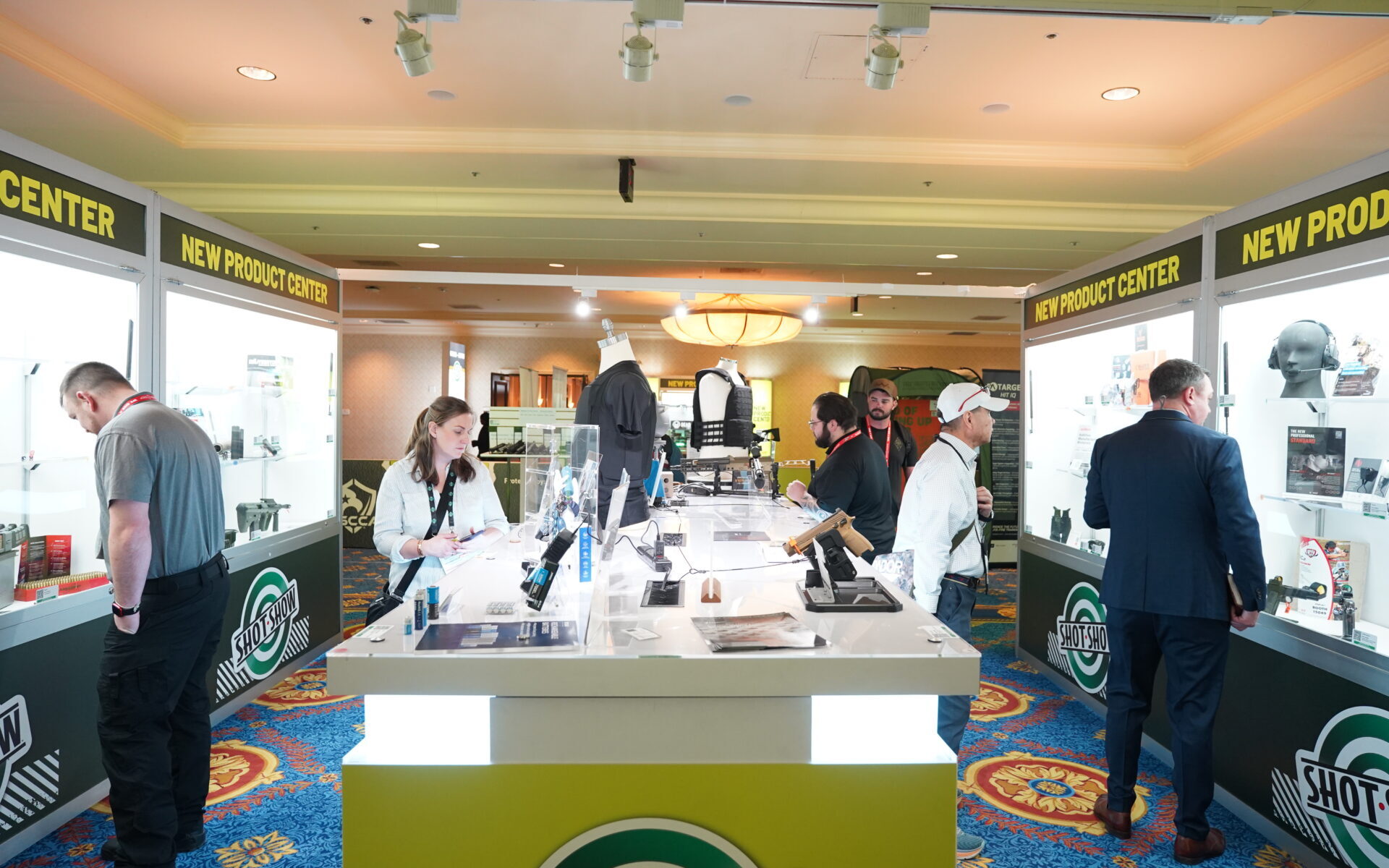
SHOT Show New Product Center exhibit floor showing firearms and outdoor industry products and retailers evaluating new product offerings

Post-SHOT Show Buying Strategy: How Firearms & Outdoor Businesses Can Avoid Costly Inventory Mistakes

Each year, SHOT Show introduces hundreds of new firearms, optics, ammunition offerings, and accessories. For firearms and outdoor businesses, the challenge isn’t finding new products — it’s choosing the right ones.

The excitement of SHOT Show can easily lead to rushed buying decisions that strain cash flow and result in slow-moving inventory. Successful retailers and manufacturers step back after the show and follow a disciplined, data-driven buying strategy.

This guide outlines a practical post-SHOT Show buying framework designed to reduce risk, protect margins, and align inventory with real customer demand.


The Post-SHOT Show Excitement — and the Risk It Creates

SHOT Show is energizing.
New firearms platforms.
New optics technologies.
New ammunition and accessories.

For small and mid-size firearms businesses, that excitement can also create pressure to:

  • Buy early
  • Buy big
  • Beat competitors to new products

That pressure is often where inventory mistakes begin. New products do not automatically equal profitable products.


Step 1: Revisit Your Financial Reality Before Buying

Before placing any post-SHOT Show orders, businesses should evaluate their financial position.

Key areas to review include:

  • Cash flow availability
  • Open-to-buy budget
  • Inventory carrying costs
  • Outstanding vendor balances

If the financial foundation isn’t solid, new products will not fix underlying problems. Inventory should support financial stability — not undermine it.


Step 2: Analyze at Least Five Years of Your Sales Data

Industry trends matter, but your historical sales data matters more.

Retailers should review at least five years of location-specific data to identify:

  • What products actually sold
  • Seasonal demand patterns
  • Price points that consistently move
  • Products that looked promising but underperformed

SHOT Show highlights what’s new. Your data reveals what works in your market.


Industry Example: When Buzz Fades but Inventory Remains

A common post-SHOT Show scenario:
A new pistol launches with heavy marketing and early excitement. Within a few months, distributors begin discounting inventory as demand softens.

Retailers who reviewed historical handgun sales avoided overbuying. Those who chased buzz often tied up capital in slow-moving stock.

The lesson is simple: hype fades, but inventory remains.


Step 3: Online vs. Brick-and-Mortar Buying Strategies

Buying strategies should reflect how a business sells.

Brick-and-mortar focused retailers typically prioritize:

  • Proven sellers
  • Hands-on customer appeal
  • Local market demand

Retailers with online sales capabilities may:

  • Test specialty SKUs
  • Carry niche calibers or limited runs
  • Reduce in-store inventory risk

One buying strategy rarely fits both channels.


Step 4: Ask Customers Before You Buy

Customer feedback is one of the most underused tools in the firearms industry.

Retailers can send simple email surveys asking customers to:

  • Review a list of new SHOT Show products
  • Select their top five interests
  • Share why they prefer certain products

This approach:

  • Reduces guesswork
  • Builds anticipation
  • Improves sell-through rates

Your customers often provide better forecasting insight than manufacturers or distributors.


Step 5: Use Simple Tools to Improve Buying Decisions

Market research does not need to be complicated.

Effective tools include:

  • Email survey platforms (Mailchimp, Constant Contact, Google Forms)
  • Social media polls on LinkedIn, Facebook, and Instagram
  • Sales analytics and inventory management software
  • Recent industry reports and market data

Good tools support better decisions — especially during post-SHOT Show buying cycles.


Balancing Local Markets with Industry Trends

Successful firearms businesses understand their local market while staying aware of broader trends.

Local factors such as geography, customer demographics, and use-cases matter. At the same time, ignoring emerging trends can lead to stagnant sales.

The goal is selective adoption — informed by data, customer feedback, and market analysis.


Final Thoughts: Strategy Beats Hype After SHOT Show

SHOT Show inspires innovation. Profitability comes from disciplined execution.

The right products aren’t just new — they are right for your business, your customers, and your market.

Firearms and outdoor businesses that use data-driven buying strategies are better positioned to protect cash flow, avoid overbuying, and sustain long-term growth.


About Virginia Innovations, Inc.

Virginia Innovations, Inc. provides firearms industry consulting, market analysis, and professional firearms appraisals for retailers, manufacturers, collectors, and estates.

Our work helps firearms businesses make informed, defensible decisions grounded in data and industry expertise.

The Rise of the Informed Firearms Consumer

Why transparency, accuracy, and education now define success in the firearms industry

The firearms industry is experiencing a fundamental shift. Today’s buyers are no longer passive consumers who rely solely on brand reputation or sales claims. Instead, they are informed, analytical, and documentation driven. They research before they buy, verify before they trust, and expect accuracy at every step of the transaction.

For manufacturers, retailers, collectors, and estates, this change is not a challenge, it’s an opportunity. Those who adapt by prioritizing transparency, defensible information, and professional insight are the ones who will earn long-term credibility and loyalty.

Firearms industry consulting workspace showing market analysis and business strategy tools

A New Generation of Firearms Buyers

Modern firearms consumers arrive educated. Many have already reviewed:

  • Historical production data
  • Manufacturer specifications
  • Collector forums and auction records
  • Market trends and recent sales comparisons

They expect product descriptions to be correct, historical claims to be verifiable, and valuations to be clearly explained. Vague language, unsupported claims, or “trust us” pricing no longer work.

In short, credibility has become currency.


Transparency Is No Longer Optional

Transparency is not just about honesty, it’s about documentation.

Buyers increasingly want to understand:

  • Why a firearm is valued at a certain price
  • How condition, originality, and rarity affect worth
  • What sources support historical or manufacturing claims

Clear explanations reduce confusion, protect all parties involved, and signal professionalism. When information is presented accurately and supported by research, trust follows naturally.


Accuracy Protects Both Buyer and Seller

In today’s environment, incorrect details can create real risk. Misstated calibers, incorrect manufacturing dates, or unsupported provenance claims can lead to disputes, reputational damage, or legal exposure.

From a consulting perspective, accuracy is risk management.

Well-documented descriptions and defensible valuations:

  • Reduce liability
  • Strengthen compliance with legal and ethical standards
  • Provide clarity during insurance, estate, or donation scenarios

Professional insight ensures that information can withstand scrutiny—whether from a collector, an insurer, or a regulatory authority.


The Influence of Online Video: Expertise vs. Misinformation

Online video has become one of the most powerful influences on today’s firearms consumers. Video platforms, livestream reviews, and short-form content often shape buyer perceptions long before a customer ever speaks with a dealer, appraiser, or consultant.

This creates both opportunity and risk.

While many creators provide helpful insights, others unintentionally—or deliberately—spread incorrect or oversimplified information. Manufacturing dates, rarity claims, safety assumptions, historical context, and market values are frequently misstated, taken out of context, or repeated without verification.

For informed buyers, this matters. For businesses, it directly impacts sales.


How Misinformation Affects Buying Decisions

Inaccurate video content can:

  • Inflate or suppress perceived value
  • Create unrealistic expectations about rarity or condition
  • Lead buyers to distrust legitimate pricing
  • Cause hesitation or lost sales when claims conflict

When a customer arrives convinced by incorrect information, the burden shifts to the professional to explain, correct, and document—often in real time. Without authoritative support, even accurate information can be dismissed as “just another opinion.”


Overcoming Fake Information with Verifiable Facts

The solution is not to compete with online personalities—it is to outperform them with credibility.

Professional documentation, defensible research, and clear explanations allow businesses to counter misinformation without confrontation. When conclusions are supported by:

  • Manufacturer records
  • Historical references
  • Conditional standards
  • Market-based valuation methodology

The conversation changes. Buyers recognize the difference between entertainment-driven content and professional analysis. Transparency becomes a competitive advantage—and a sales tool.


Education Builds Long-Term Trust

Education is the bridge between transparency and confidence.

When businesses take the time to explain:

  • Market forces affecting value
  • Differences between original and altered condition
  • Historical context behind specific models

They empower their clients. An educated customer is more likely to make informed decisions, return for future services, and refer others. Rather than weakening sales, education strengthens relationships.


The Consulting Advantage

This shift toward informed consumers highlights the growing importance of professional firearms consulting.

Clear documentation and expert analysis:

  • Provide objective, third-party credibility
  • Support defensible pricing and appraisals
  • Help businesses communicate complex information clearly

Consulting is no longer just about solving problems—it’s about preventing them by establishing clarity from the start.


Looking Ahead

The rise of the informed firearms consumer is not a passing trend. It reflects broader expectations for accountability, professionalism, and expertise across the industry.

Those who invest in transparency, accuracy, and education will stand apart—not just as sellers, but as trusted authorities. In a marketplace shaped by online content, authority belongs to those who can prove their claims.

For the firearms industry, the future belongs to those who understand that knowledge isn’t just power—it’s trust.


This article serves as the foundation for our ongoing discussion on firearms consulting, appraisals, and historical research. Future posts will explore practical ways businesses and collectors can adapt to this more informed marketplace.