
Growing Without Giving Up Control
Launching a firearms manufacturing company is capital-intensive by nature. Tooling, materials, subcontracted components, compliance, testing, inventory, and marketing all require cash—often long before consistent revenue begins to flow.
For many emerging manufacturers, traditional options such as venture capital, majority investors, or long-term loans are either undesirable or impractical. Giving up control too early, taking on excessive debt, or committing to repayment schedules that don’t match production cycles can put a promising product at risk.
Fortunately, there are creative, incremental capital strategies that allow firearms manufacturers to grow, validate demand, and improve cash flow—without surrendering ownership or autonomy. These strategies are especially effective for companies that subcontract component manufacturing and perform final assembly or finishing in-house.
The Capital Reality of Modern Firearms Manufacturing
Most new firearms manufacturers today operate in a hybrid production environment:
- Barrels, receivers, or components produced by subcontractors
- Final assembly, fitting, finishing, and QC performed in-house
- Small production runs to control risk and validate demand
- Limited working capital tied up in parts and inventory
This model reduces upfront capital investment in machinery but increases dependence on cash flow timing. Capital is often needed in short bursts—materials, production runs, marketing pushes—rather than one large infusion.
That reality creates an opportunity for alternative funding structures.
Inventory-Based Investing: Funding Production, Not the Company
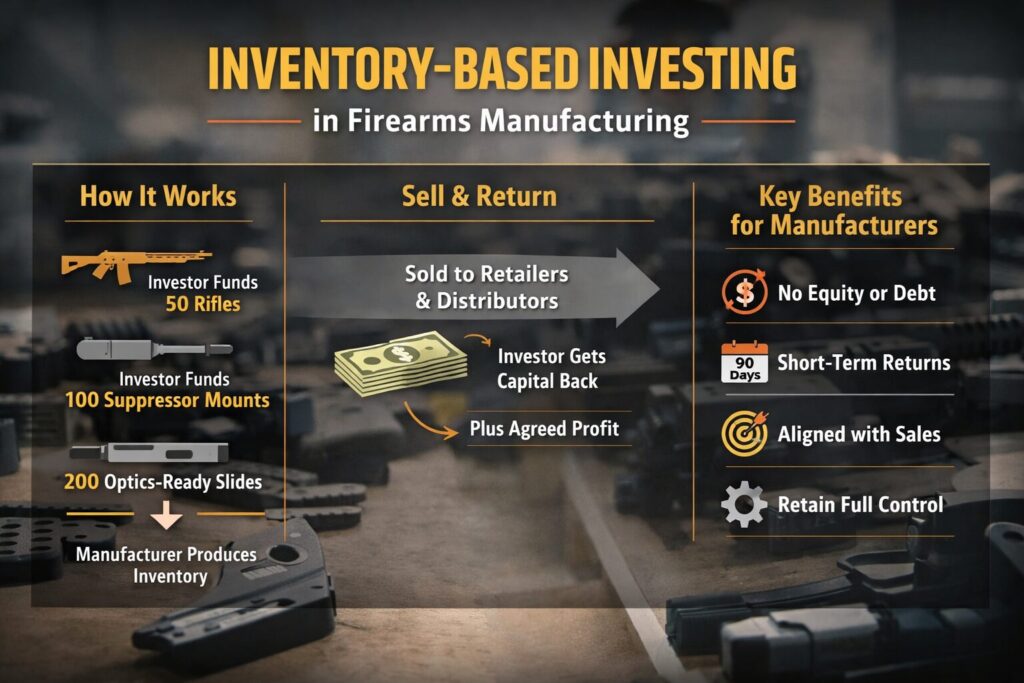
One of the most effective short-term capital strategies is inventory-based investing.
How It Works
Instead of investing in the company itself, an investor funds the production of a specific quantity of product—for example:
- 50 rifles
- 100 suppressor mounts
- 200 optics-ready slides
The manufacturer produces and sells that inventory through existing retail or distributor channels. Once the inventory sells, the investor receives:
- Their original capital
- A pre-agreed fixed return (not equity, not revenue share)
Why This Works for Firearms Manufacturers
- Investors understand exactly what they are funding
- Risk is tied to sell-through, not company ownership
- Manufacturers retain full control
- Short investment horizon (often 60–120 days)
- Easy to scale as demand increases
This model is particularly attractive to:
- Industry insiders
- Retailers
- Enthusiasts who believe in the product
Key advantage: Capital is directly aligned with production and sales, not long-term valuation speculation.
Retailer Partnerships as Capital and Marketing Engines
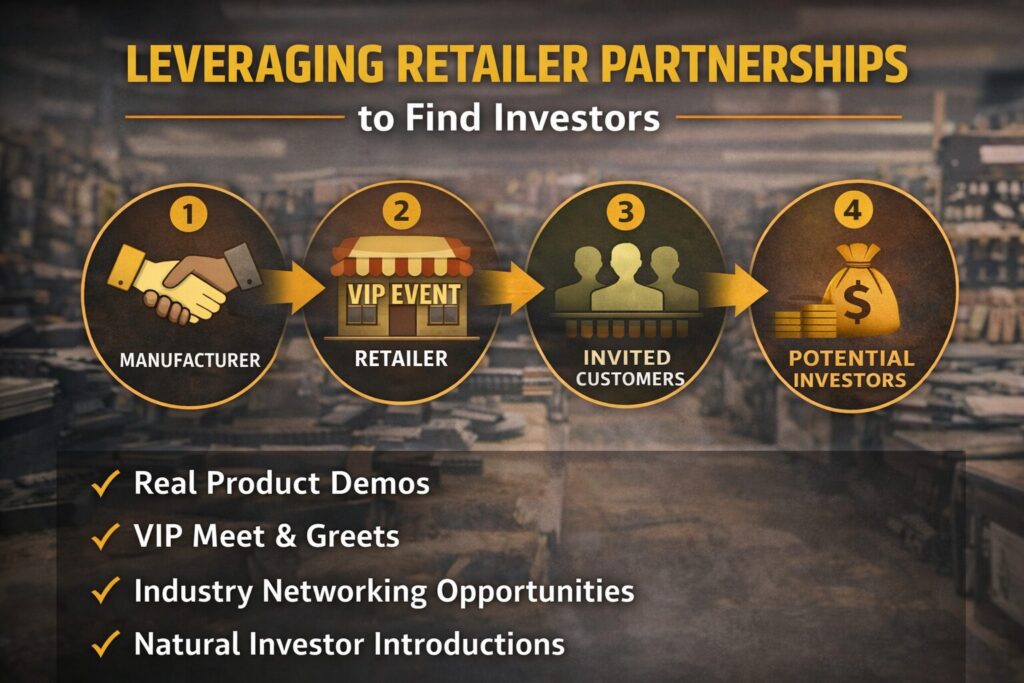
Retailers are often overlooked as a capital resource—but they shouldn’t be.
Many firearms retailers already operate VIP programs, private events, range memberships, or invitation-only customer groups. These environments are ideal for introducing new manufacturers and products.
Strategic Retailer Collaborations
Rather than approaching retailers strictly as buyers, manufacturers can create collaborative partnerships, such as:
- Exclusive early-release products
- Retailer-hosted demo days
- Meet-and-greet events with the manufacturer
- Limited-run models branded for the retailer
When retailers are genuinely excited about a product, they often become advocates—not just sellers.
VIP Events and Demo Days as Investor Discovery Tools
High-end retailers with VIP clientele offer a unique opportunity: capital exposure without a pitch deck.
How This Strategy Works
- Manufacturer partners with a retailer for a private demo or event
- VIP customers experience the product firsthand
- Manufacturer shares the product story, development process, and growth vision
- Interested attendees are introduced to small, structured investment opportunities, such as inventory-based investing
This approach works because:
- Attendees already trust the retailer
- They value exclusivity and access
- They often have disposable capital
- They are emotionally connected to the product
These events blur the line—in a good way—between customer, advocate, and investor.
Multiple Small Investors Instead of One Controlling Partner
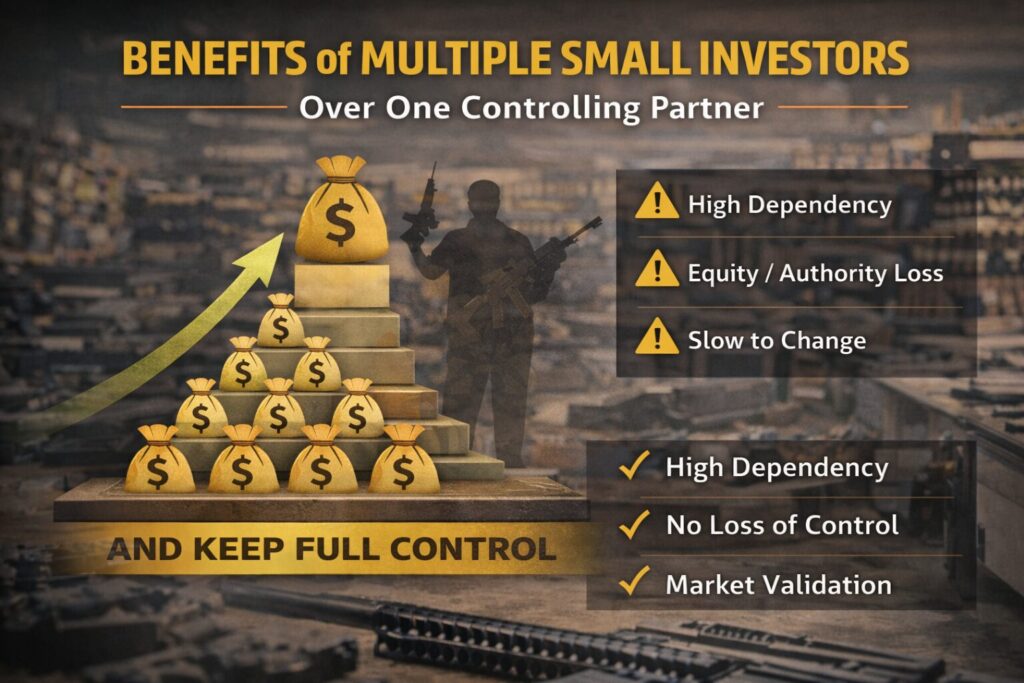
One of the biggest mistakes new manufacturers make is believing they need one large investor to succeed.
In reality, many companies grow faster and safer by securing:
- Multiple small capital contributors
- Short-term, purpose-driven investments
- Repeat investors as confidence builds
Benefits include:
- Reduced dependency on a single individual
- No loss of strategic control
- Organic validation of product demand
- Stronger industry relationships
As excitement grows and sales data accumulates, cash flow improves—and future capital becomes easier and less expensive to secure.
Why This Matters in a Subcontracted Manufacturing Model
When parts are outsourced and final assembly happens in-house, capital is often locked in:
- Deposits to subcontractors
- Work-in-progress inventory
- Finished goods awaiting sell-through
Creative capital strategies allow manufacturers to:
- Fund production runs efficiently
- Avoid overproduction
- Match capital deployment to actual demand
- Scale responsibly without overextending
This is especially critical in the firearms industry, where market shifts, regulatory pressure, and consumer trends can change quickly.
Final Thoughts: Capital Should Support Growth, Not Control It
Emerging firearms manufacturers don’t need to give away the company to grow. By thinking creatively—leveraging inventory-based investing, retailer partnerships, VIP experiences, and multiple small investors—manufacturers can:
- Maintain ownership and vision
- Improve cash flow
- Validate market demand
- Build long-term industry relationships
The key is aligning capital with production, sales, and excitement, rather than chasing traditional funding models that don’t fit the realities of firearms manufacturing.
Consulting Insight
At Virginia Innovations, Inc., we help firearms manufacturers structure realistic growth strategies, analyze production economics, and develop retailer and investor-friendly programs that align with real-world industry dynamics.
If you found this discussion helpful, you can explore more firearms industry insights on our blog, where we cover manufacturing strategy, valuations, market trends, and growth planning for companies across the industry.