Virginia has now enacted one of the most consequential firearm industry liability laws in the country. SB27 – Firearm Industry Members; Standards of Responsible Conduct; Civil Liability has passed the Virginia General Assembly and will soon become part of the Commonwealth’s legal framework governing firearm manufacturers, distributors, and retailers operating in the state.
The legislation passed largely along party lines. In the Virginia Senate, the bill passed 21–19, with all 21 Democratic senators voting in favor and all 19 Republican senators voting in opposition. In the Virginia House of Delegates, the measure passed 62–36, with the Democratic majority providing the votes required for passage.
But with the political debate now concluded, a far more practical and unanswered question emerges—one that affects nearly two thousand firearms-related businesses operating in Virginia:
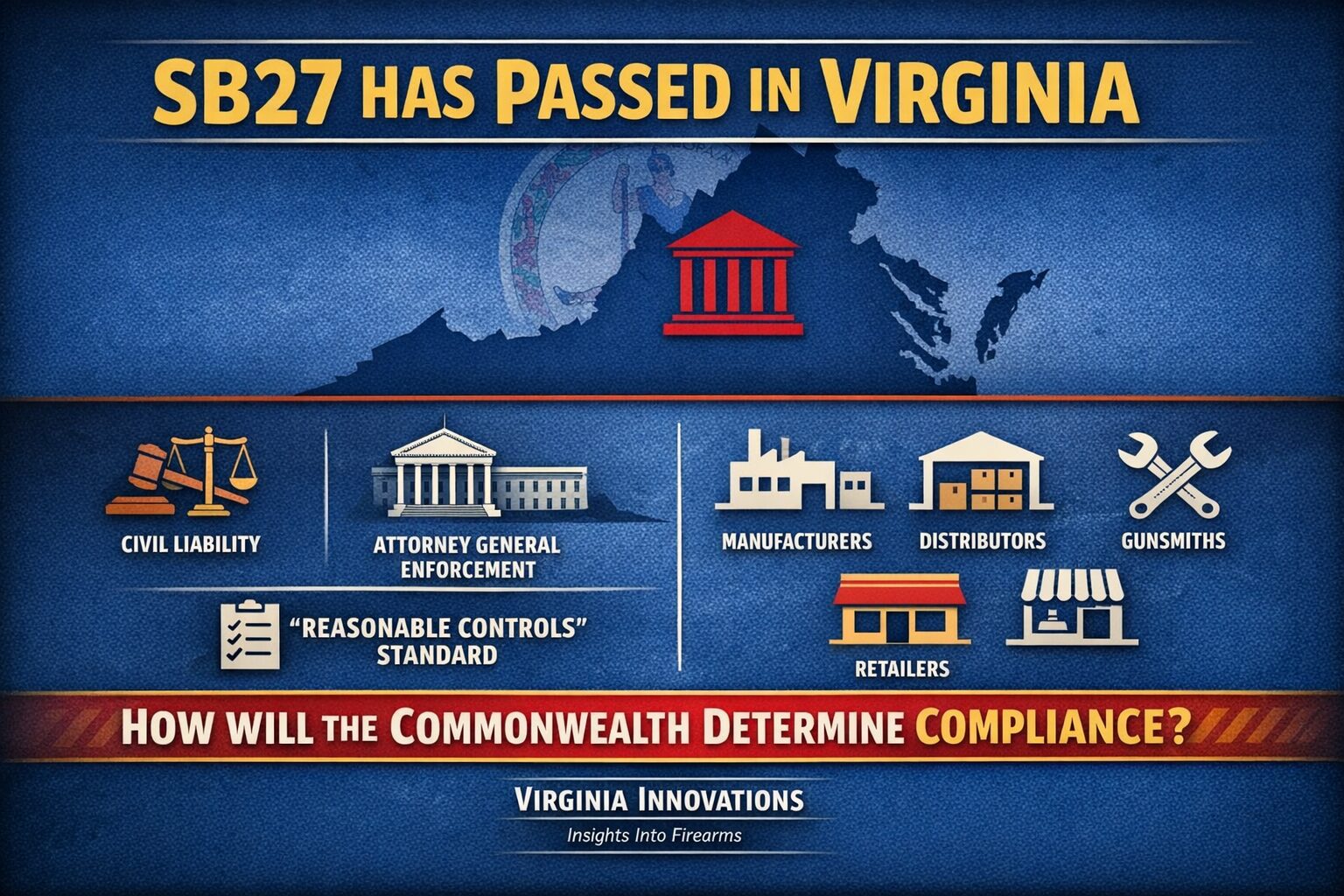
How exactly does the Commonwealth intend to enforce SB27 and determine whether a firearm industry member is in compliance?
The law establishes new “standards of responsible conduct” and requires firearm industry members to implement “reasonable controls” designed to prevent unlawful firearm misuse. It also creates new avenues for civil lawsuits brought by the Attorney General, local government attorneys, or private individuals claiming injury.
Yet the statute raises a fundamental operational question. Unlike many other regulated industries, SB27 does not clearly define the regulatory framework that will determine whether those “reasonable controls” are sufficient before litigation begins.
Understanding the real-world implications of SB27 requires examining several key elements of the law and comparing them with how similar regulatory frameworks operate in other industries.
1. The Scope Problem: Who Is a “Firearm Industry Member”?
SB27 applies broadly to “firearm industry members” involved in the manufacture, distribution, importation, marketing, or sale of firearm-related products. While this language may appear straightforward, the structure of the modern firearms industry reveals a far more complex ecosystem of participants whose roles vary widely.
The firearms marketplace operates through several layers. Manufacturers design and produce firearms and related components. Importers bring foreign-made products into the United States. Distributors move inventory through the wholesale market. Retailers—typically federally licensed firearms dealers—conduct the final transfer to consumers through the federally mandated background check system.
Beyond these core participants, the industry also includes auction houses that handle estate firearm sales, gunsmiths who perform repairs or modifications, consultants who advise businesses on operations and compliance, and marketing firms responsible for promoting firearm-related products.
This raises a significant question regarding legal responsibility. If a firearm moves through a lawful chain of commerce—from manufacturer to distributor to licensed dealer—and later becomes associated with criminal misuse, which participant in that chain bears responsibility? Could liability extend upstream to manufacturers or distributors who had no direct contact with the purchaser? Could a marketing firm be drawn into litigation because its advertising materials are interpreted as contributing to unlawful firearm use?
Other highly regulated industries address this issue through carefully defined statutory roles. In the pharmaceutical industry, for example, the Food and Drug Administration regulates manufacturers, distributors, and pharmacies under separate compliance frameworks tailored to their specific responsibilities. Similarly, financial services regulation distinguishes between banks, broker-dealers, and investment advisers, each operating under different oversight structures.
SB27 introduces liability across a broad category of “industry members,” yet it does not clearly delineate where responsibility begins and ends within the firearms supply chain.
2. The “Reasonable Controls” Standard
The law requires firearm industry members to implement “reasonable procedures, safeguards, and business practices” intended to prevent unlawful firearm activity. These measures are designed to prevent straw purchases, firearm trafficking, sales to prohibited persons, theft or loss of firearms, and marketing practices that promote unlawful use.
The difficulty lies in the definition of “reasonable.”
The firearms industry is already subject to extensive federal regulation administered by the Bureau of Alcohol, Tobacco, Firearms and Explosives (ATF). Federally licensed dealers must comply with strict requirements including background checks, detailed transaction records, inventory tracking, and federal inspections.
Many responsible dealers already implement safeguards beyond federal requirements. These often include employee training programs, internal compliance audits, surveillance systems, secure storage protocols, and transaction monitoring practices designed to identify suspicious purchasing behavior.
However, SB27 introduces a new legal expectation for “reasonable controls” without clearly defining what those controls should entail or how businesses should measure whether their procedures satisfy the new standard.
Other industries offer useful comparisons. Financial institutions must implement anti-money laundering programs and “Know Your Customer” procedures, but those requirements are accompanied by detailed regulatory guidance issued by agencies such as the Financial Crimes Enforcement Network and the Office of the Comptroller of the Currency. Similarly, pharmaceutical manufacturers must comply with FDA-defined Good Manufacturing Practices, which provide extensive documentation describing exactly how compliance will be evaluated.
SB27 establishes a new compliance expectation but does not yet provide the equivalent regulatory framework defining how that expectation will be interpreted in practice.
3. The Enforcement Mechanism: Civil Liability and Public Nuisance
Perhaps the most notable structural feature of SB27 is that it relies primarily on civil liability enforcement rather than traditional regulatory oversight.
Under the law, enforcement actions may be brought by the Virginia Attorney General, by local county or city attorneys, or by private individuals claiming injury resulting from alleged violations. The law also introduces the concept that firearm industry members may not knowingly or recklessly contribute to a public nuisance through the manufacture, distribution, or marketing of firearm-related products.
This legal strategy mirrors legislation adopted in states such as New York and California, where public nuisance theories have been used to pursue firearm manufacturers and distributors despite federal protections provided by the Protection of Lawful Commerce in Arms Act (PLCAA).
In practice, this means that compliance may not be determined through routine inspections or regulatory audits. Instead, it may be determined through litigation after an incident occurs and a lawsuit is filed.
In many other industries, civil liability supplements a well-defined regulatory structure. Automobile manufacturers, for example, may face product liability claims, but they also operate within a comprehensive regulatory framework administered by the National Highway Traffic Safety Administration.
SB27 raises the possibility that compliance standards for firearm industry members may instead be shaped primarily through court decisions interpreting the statute after disputes arise.
4. How Similar Laws in New York and California Are Being Used
Virginia is not the first state to adopt this type of legislation. New York and California have already enacted similar laws that provide insight into how such statutes may function.
New York’s law became a national test case in National Shooting Sports Foundation v. James, where the firearms industry challenged the statute as conflicting with the federal PLCAA. In July 2025, the United States Court of Appeals for the Second Circuit rejected a broad facial challenge and allowed the law to remain in effect while future case-by-case litigation determines its limits.
New York has also begun actively enforcing its law. In People v. Arm or Ally, the state pursued claims involving unfinished firearm receivers and related ghost gun sales. In March 2024, judgment in excess of $7.8 million was entered against one of the defendants along with injunctive relief.
Another case, People v. Bowman’s Gun Shop, filed in 2025, alleged that a dealer failed to implement sufficient security procedures and compliance safeguards. In February 2026, a federal court ruled that the case should proceed in state court.
California enacted the Firearm Industry Responsibility Act (AB 1594), which similarly imposes duties on firearm industry members to adopt reasonable controls. However, portions of the law were blocked in federal court in National Shooting Sports Foundation v. Bonta, where a judge issued a preliminary injunction against certain provisions related to “abnormally dangerous” firearm products.
Despite that injunction, California officials continue pursuing related litigation involving firearm manufacturing files and digital distribution networks.
These examples illustrate an important point: once enacted, laws like SB27 often become platforms for ongoing civil litigation, allowing attorneys general and private plaintiffs to test new legal theories regarding firearm industry conduct.
5. How SB27 May Attempt to Navigate Around the Federal PLCAA
At the center of the national debate over firearm industry liability is the Protection of Lawful Commerce in Arms Act (PLCAA), enacted by Congress in 2005. PLCAA was designed to prevent firearm manufacturers and sellers from being held liable for crimes committed by individuals who unlawfully misuse firearms.
However, PLCAA includes several exceptions. One of the most important is the “predicate exception,” which allows lawsuits alleging violations of state or federal statutes governing firearm sales or marketing.
Many legal analysts believe that modern state laws—including those enacted in New York, California, and now Virginia—are designed specifically to function as such predicate statutes.
By creating new legal duties, such as standards of responsible conduct and requirements for reasonable controls, states may be attempting to create the legal foundation necessary for civil lawsuits that could survive PLCAA protections.
Whether this strategy ultimately succeeds will likely be determined through years of litigation. The New York cases demonstrate that courts may allow such statutes to exist while leaving their ultimate scope to future case-by-case rulings.
6. The Operational Impact on Virginia Firearms Businesses
Virginia’s firearms industry extends well beyond retail gun stores. According to federal licensing data from ATF reports in 2025, Virginia had approximately:
- 1,241 firearm dealers (Type 01)
- 142 pawnbroker firearm dealers (Type 02)
- 464 firearm manufacturers (Type 07)
- 60 firearm importers
- 37 ammunition manufacturers
Combined, these categories represent a large and diverse firearms industry operating within the Commonwealth.
Using the traditional dealer classifications of Type 01 and Type 02 license holders, Virginia had roughly 1,383 retail-class firearm dealers in 2025. Broader counts that include manufacturers and importers place the number of firearms-related businesses closer to 1,900 licensed participants statewide.
The significance of these numbers is that SB27 does not apply only to storefront retailers. Its language potentially extends liability across the entire firearms supply chain.
Manufacturers may face questions regarding product design and distribution practices. Importers may face scrutiny over products entering the Virginia marketplace. Distributors may face liability regarding downstream sales practices. Retailers may face new compliance burdens related to security procedures, transaction monitoring, and inventory safeguards.
Unlike many other industries where regulatory frameworks distinguish between participants in the supply chain, SB27 risks applying a single liability framework across a diverse set of industry roles.
7. The Central Question Remains
With SB27 now passed by the Virginia General Assembly, the question is no longer whether the law will exist—it will.
The question is how it will function in practice.
If the Commonwealth intends to hold firearm industry members to a defined standard of responsible conduct, policymakers must also define the mechanisms through which compliance will be determined before legal disputes arise.
In most regulated industries, compliance is determined through regulatory guidance, inspections, and oversight by specialized agencies. Businesses understand the expectations placed upon them and have the opportunity to demonstrate compliance through established procedures.
SB27 leaves open the possibility that compliance may instead be determined primarily through litigation.
For businesses attempting to operate responsibly within the law, that distinction matters greatly.
What Questions Virginia Policymakers Should Answer Before SB27 Takes Effect
With SB27 now passed and moving toward implementation, policymakers should recognize that the effectiveness of any regulatory framework depends not only on statutory language but also on how that framework is administered in practice. If the Commonwealth intends to hold firearm industry members to a defined standard of responsible conduct, several fundamental questions should be addressed before enforcement begins.
First, what specific compliance standards will define “reasonable controls”? The statute uses broad language describing safeguards, procedures, and business practices intended to prevent unlawful firearm misuse. Yet without clear regulatory guidance describing what those safeguards must include, businesses will have difficulty determining whether their internal policies meet the expectations of the law. In many regulated industries, agencies publish compliance manuals, inspection criteria, and interpretive guidance to ensure that businesses understand their obligations before enforcement actions occur.
Second, which state agency—or combination of agencies—will be responsible for overseeing compliance? Unlike other heavily regulated industries such as banking, pharmaceuticals, or environmental compliance, Virginia does not currently maintain a dedicated regulatory body responsible for supervising the firearms retail or manufacturing sector beyond federal oversight administered by the Bureau of Alcohol, Tobacco, Firearms and Explosives. If SB27 introduces new standards of conduct, policymakers may need to clarify which institutions will provide guidance and oversight.
Third, will businesses be provided with safe harbor protections for good-faith compliance efforts? Many regulatory systems include safe harbor provisions that protect companies that implement documented compliance programs aligned with published standards. Without such protections, even businesses operating responsibly could face costly litigation simply because their internal controls are later deemed insufficient through court interpretation.
Fourth, how will SB27 interact with existing federal regulatory frameworks? The firearms industry is already subject to extensive federal licensing, record-keeping, and compliance requirements. If Virginia introduces additional standards without clear alignment with federal regulatory practices, businesses may face conflicting expectations that complicate compliance efforts.
Finally, policymakers may wish to consider how enforcement actions will affect Virginia’s broader firearms industry ecosystem. As current federal licensing data indicates, the Commonwealth is home to a diverse network of firearm-related businesses including retailers, manufacturers, importers, ammunition producers, and other federally licensed entities. Any enforcement framework that relies heavily on litigation rather than regulatory clarity could produce unintended consequences for businesses attempting to operate responsibly within the law.
Addressing these questions does not change the statute that has been enacted. However, answering them clearly could determine whether SB27 ultimately functions as a predictable regulatory framework—or as a source of prolonged legal uncertainty for both the industry and the Commonwealth itself.
Final Thought
The firearms industry—like any other regulated industry—can adapt to clear rules and well-defined compliance standards.
But effective regulation requires more than broad statutory language. It requires clear definitions, measurable standards, administrative oversight, and predictable enforcement mechanisms.
Until those elements are clearly articulated, SB27 leaves one fundamental question unanswered:
How exactly does the Commonwealth intend to determine who is compliant—and who is not?